

Emirati Doctor’s Voice Cloned for Commercial Promotion
A local dermatologist was surprised to falsify his voice using artificial intelligence techniques, to promote a medical product he never talked about or recommended, warning against taking any information promoting his name except through himself, or through his official social media pages.
A legal adviser confirmed that "this crime is classified as punishable by law as cyber-fraud".
A cybersecurity expert stressed the "necessity for community members to acquire methods and tools to distinguish between fake and genuine".
Dr. Anwar Al Hammadi, assistant professor of medicine and health sciences at Mohammed bin Rashid University, said in detail that he "does not advertise or promote medical products, and his talk to his followers through his social media platforms is limited to health awareness and education about various diseases and how to prevent them".
He added: "I follow the news of the latest medicines appearing globally in the treatment of various skin diseases, and the minds of patients and followers about them to give them hope for a cure, and to consult their doctors for new treatments", stressing at the same time that "not everything on the market is believable".
He explained: "As for the fake video, his fakers exploited the confidence of patients and followers of my medical opinion, and professionally falsified my voice when mentioning the name of the drug and replacing it with another drug, in order to promote it commercially in an outright fraudulent crime", referring to the discovery of the falsification by followers who knew him well, after noticing a difference in the way he spoke that raised their doubts about him.
He said that "if the perpetrators of this crime are confirmed to be inside the state, legal action will be taken against them, to curb these practices that damage the reputation of well-known doctors, and to protect patients from their disastrous consequences".
Al-Hamad warned patients and followers not to collect their medical information through social media, which "has become a deterrent to fraudsters", pointing out the need to take it directly from qualified doctors, avoiding misleading publicity. He urged stakeholders to continue raising health awareness about these issues.
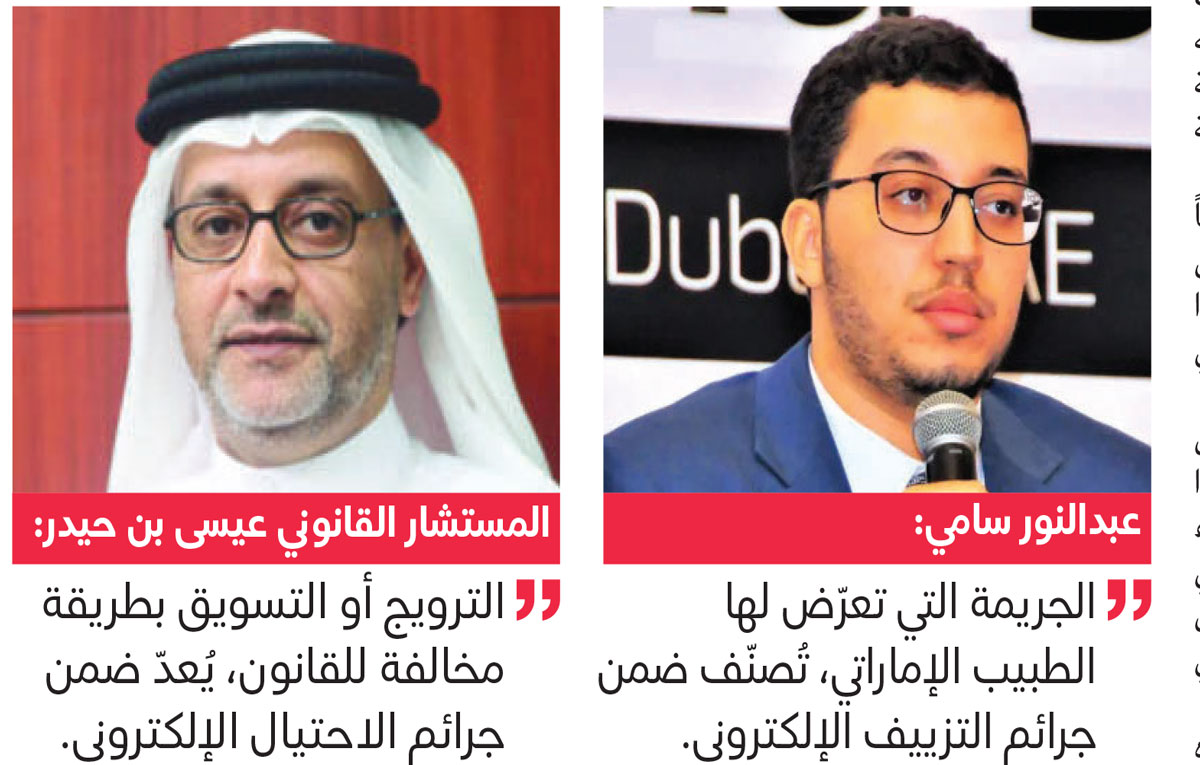
For his part, information technology and cybersecurity adviser Sami A Nour said, "The crime of an Emirati doctor is classified as cyber counterfeiting crimes that people or entities resort to using simple electronic technologies or artificial intelligence technologies".
He pointed out that there are signals by which the viewer can distinguish between real and fake clips, most notably noticing any change in sound level, whether high or low, if the video sound is at one level without changing the frequency and tone of the speaker, and if the sound is noise-free, i.e. in a state of complete silence.
He stressed that the most prominent ways to prevent these fraudulent practices are visiting the official page of the speaker, especially if he is a celebrity, searching for the product being promoted and evaluated by different users and bodies, noting that scammers typically use informal pages under different names.
He said that "artificial intelligence technologies have made it easier for fraudsters to do their job, and the difficulty of detecting them by unskilled people has increased the number of victims".
He said that "the basic problem with cyber-fraud operations is the low level of knowledge of the modern technologies used, and the inability of many to distinguish between real and fake", stressing the need to refer to the pages and official websites of the people and products on display to ensure the safety of the advertisements promoted.
Legal adviser Eisa bin Haider stated that promotion or marketing in a illegal manner is one of the crimes of cyber-fraud, explaining that according to the law "it is punishable by imprisonment and a fine of not less than AED20,000 and not more than AED500,000, or by one of these two penalties, each committed via an information network, an information technology medium or a website. Actions that would promote a good or service through misleading advertising or a method involving incorrect data, such as advertising, promotion, mediation, handling of any form, or encouragement to handle a virtual, digital currency, stored-value unit or any unrecognised payment unit in the State, or without obtaining permission from the competent authority".
Bin Haider added: "It is punishable by imprisonment for a period of at least six months and a fine of not less than AED 150,000 and not more than AED 500,000, or by one of these two penalties, anyone who uses an information network, electronic information system, or an information technology medium, with the intention of violating a person's privacy or the privacy or family privacy of individuals without consent, Except in circumstances authorised by law, it is prohibited to eavesdrop on, intercept, record, transmit, broadcast or disclose conversations, communications or audio-visual material; photograph others in any public or private place; prepare, transmit, reveal, copy or retain electronic images; or publish news, electronic images, photographs, scenes, comments, data or information—even if accurate—with the intention of harming a person. It is also punishable by imprisonment for a period of not less than one year and a fine of not less than AED 250,000 and not more than AED 500, or by one of these two penalties, whoever uses an electronic information system, or one of the means of information technology, to make any modification or processing on a recording, image or scene, with the intention of defaming or abusing another person".
Source: Emarat Al Youm