

Parents’ Chat Groups: Family Support That Denies Students the Chance to Try
The summary .
Parental experiences make it easier to communicate and remember, but the exchange of solutions, comparisons, and information conflicts can weaken a student's independence, confuse him, and diminish trust.
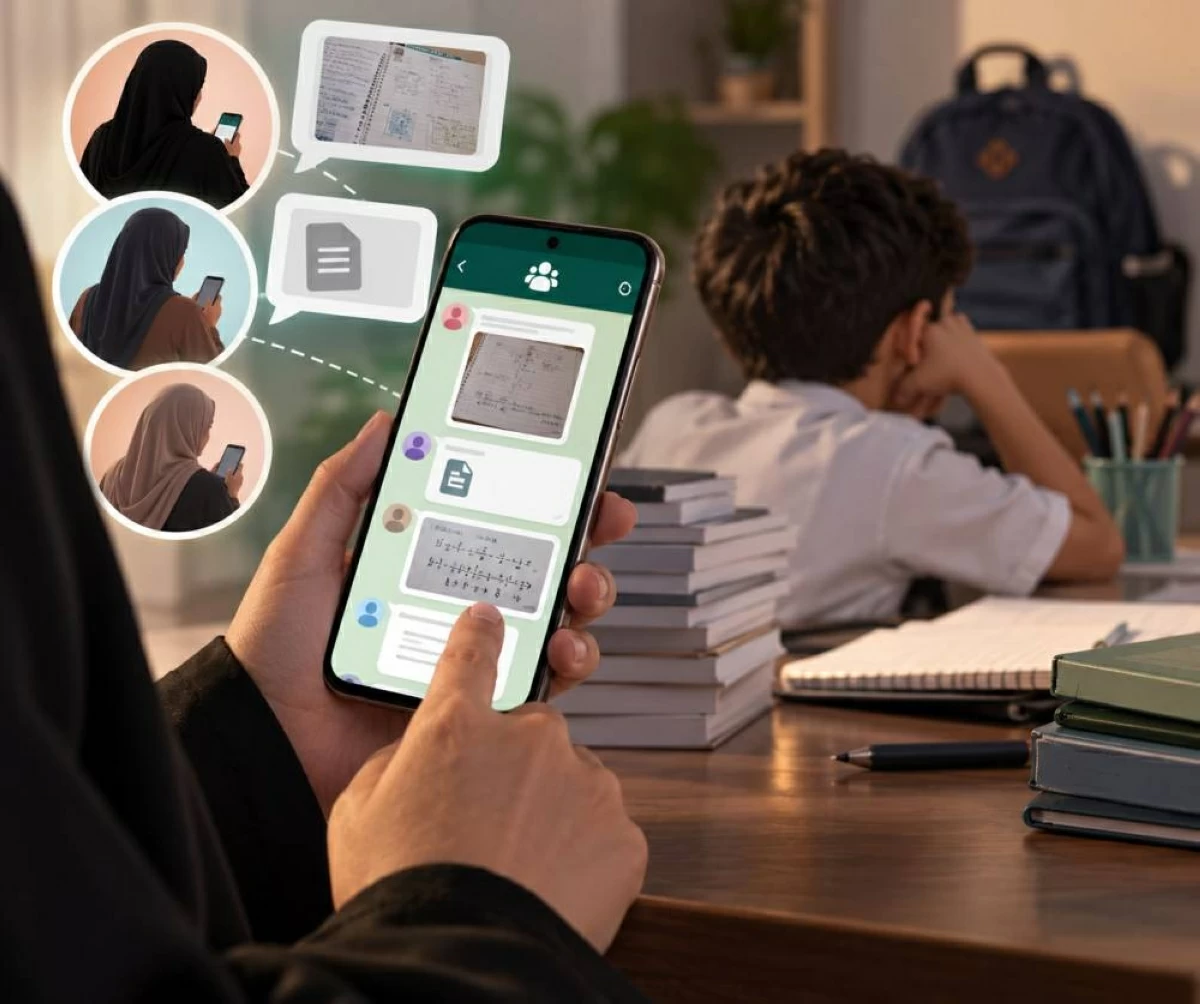
Social media parent groups have become part of the daily educational landscape for many families, and their role is no longer limited to reminding them of their schoolwork, but extends to exchanging assignment solutions, training forms, tests, discussing students' performance and grades, and continually questioning what they are asked to do in class.
These groups have evolved into a parallel learning space outside of school, while also raising questions about the gap between following children and helping them, and doing their educational responsibilities on their behalf.
Al Khaleej observed the opinions of teachers and parents, who stressed that it has positive aspects, most notably the speed of communication, remembrance of appointments and exchange of information, but its excessive use may result in negative practices, including spreading inaccurate information, comparing student levels, and depending on some children to follow their families for all details instead of them.
Take care of the families.
Sharing homework solutions and test exercises among parents through communication groups has become a practice that needs more awareness, said teacher Nadia Weld. Although the motivation behind this is that families are keen to help their children and support them in school, it denies them the opportunity to think, try, discover mistakes and correct them, pointing out that homework and exercises are not limited to getting the right answers, but a way to help the teacher know how well the student absorbs.
She added that the continuous circulation of test models and training solutions may lead some students to focus on finding the answer rather than understanding how to access it, and may also give the teacher an inaccurate picture of the student's real level, thus making it difficult to identify weaknesses, stressing that the role of the family should be focused on providing the right environment for learning, encouragement and guidance when necessary, while giving the student the opportunity to try for himself.
Confuse the student .
Parent groups on social networks are no longer just a channel for sharing school information, they become an indirect partner in the details of a student's educational life, from asking questions about duty and test, to discussing grades and achievements, to sharing information without verifying its source. A message about a test date, a task or parts required for review can spread, and then it turns out to be inaccurate, teacher Ayesha said, which could confuse the student and family. School, teacher and official channels should remain the primary source of information.
She pointed out that the comparison of children's grades and achievements within some groups could turn competition from a positive motivation into a source of stress, because students' abilities, circumstances and learning speed vary, considering that what is needed is to help the child develop his level compared to his previous performance, not to put him permanently in a race with his peers.
Ease of communication
These groups can be very useful when used correctly, helping to remember homework and appointments and facilitating communication, as well as saving time and effort for working mothers or families who have more than one child and follow up on more than one educational platform, but teacher Hadeel Sami believes that the problem begins when the group becomes a stream of messages or a space to circulate homework solutions, or a constant search for teachers' mistakes and collective objection to certain decisions.
She pointed out that the group itself is not positive or negative, but rather determines how it uses the result.
It's a quick way.
A number of mothers have spoken about the matter, with Principal Mary Aamir, a mother of two students who participates in private groups alongside her children, saying that these groups have become a quick way for them to learn about the news, especially on days when the student cannot remember all the details she reported inside the school, explaining that they benefit from asking about the delivery date of a project or school event or verifying the required duty, but try not to rely entirely on them. Because the student should be the first source to know what his duties are.
She added that she noticed that some parents send a picture of the question asking for help, and within minutes the full solution is published, and that's where the role of the help group may shift to completing the task.
Parent Alia Al Shamsi said her experience with these groups had made her more alert to ready-made answers. At first, she regarded sharing answers as a form of cooperation, but over time she noticed that her son would ask, “Did they send the answer in the group?” before attempting exercises himself. This prompted her to change how she used the group: she stopped showing him the answers it shared and asked him to try first. Then use the existing answer for review after completion if needed.
Conflicts of information
In a different experiment, parental supervisor Nadiya al-Fahdi said that what bothered her most in some groups of parents was not homework solutions but the abundance of messages and information conflicts, as someone might ask for a test date, several different answers come up, and the debate about which one was right begins, and that they have learned over time not to treat everything the group responds to as official information, and to return to school messages or the educational platform when there is a difference.
The student's confidence
The psychologist Kahita Mehrabi stressed that there are both positive and negative sides to this phenomenon, explaining that the positive side is to help groups of parents remember and clarify what is required, while the negative side is that when ready solutions reach the student continuously, others tend to think for him, and if this pattern continues over time it may affect the student's confidence in his ability to try and research. So it's best to have family support based on guidance and help the student understand what's required, while leaving the execution behind and trying.
She explained that the boundary is that the guardian directs his son, helps him organize his time, asks him the questions that lead him to think, and then leaves him responsible for the task, for the importance of developing a child's inner sense of accomplishment rather than establishing permanent dependence on others.
A sense of security .
Psychologist Khita Mehrabi said that the presence of parents in a student's educational life is important and gives him a sense of security and encouragement, but beneficial follow-up supports him without taking his turn.
Family worries .
Al-Fahdi Club believes that the existence of these groups has become a reality that is difficult to ignore, so the most important thing is not to prevent them, but to spread the culture of using them in a way that serves the student, without increasing the concern of the family or making the guardian responsible for following every academic step on behalf of his son.
Source: Al Khaleej